 Mantanetwork
 Pacific runs Ethereum-compatible contracts with ETH gas
Mantanetwork Pacific runs Ethereum-compatible applications on a separate Layer 2 network where ETH pays transaction fees. Sending a direct wallet transaction requires a Pacific connection and enough native ETH there to cover its fees. An Ethereum mainnet balance stays on Ethereum until a supported transfer reaches Pacific. Applications also depend on their deployed contracts and any assets they need.
Last updated:A wallet address can identify the same account across compatible networks while showing different balances on each. Application access therefore depends on where the contracts run and where the account holds its funds, alongside the transaction’s current fee requirement.
Pacific funds and Ethereum bridge deposits
ETH already available on Pacific can pay for local transactions; ETH on Ethereum mainnet requires a supported cross-chain transfer to become a Pacific balance. Mainnet uses chain ID 169. Selecting that network tells the wallet which chain to query and which transactions to sign. The switch doesn’t relocate assets. Even when the address stays unchanged, Ethereum and Pacific maintain separate account balances and contract state.
The native bridge connects Ethereum mainnet with Pacific for supported asset transfers, including ETH deposits. A deposit also needs Ethereum gas for its source-chain transaction. The amount intended for Pacific and the ETH budget for that Ethereum transaction serve different purposes. Sending an ordinary Ethereum transfer to an address doesn’t, by itself, deliver funds on Pacific. The bridge provides the cross-chain operation, and the destination balance determines what becomes available for local spending.
What does a Pacific transaction cost?
A Pacific transaction combines an execution fee with a separate data-related fee, so its total cost depends on computation and the applicable network conditions. Pacific uses ETH as its native currency for transaction fees. MANTA’s tokenomics don’t change that gas currency: a MANTA token balance doesn’t itself supply native ETH. A transaction’s transfer value also remains separate from its network fees.
Gas measures execution work. For an included transaction, the execution charge equals gas used multiplied by the effective gas price. The separate data fee also contributes to the total. A gas limit sets an execution allowance; it isn’t an ETH price. Increasing that limit doesn’t replenish the account. Contract calls can require different amounts of work, so a fee estimated for one operation shouldn’t become a fixed budget for another.
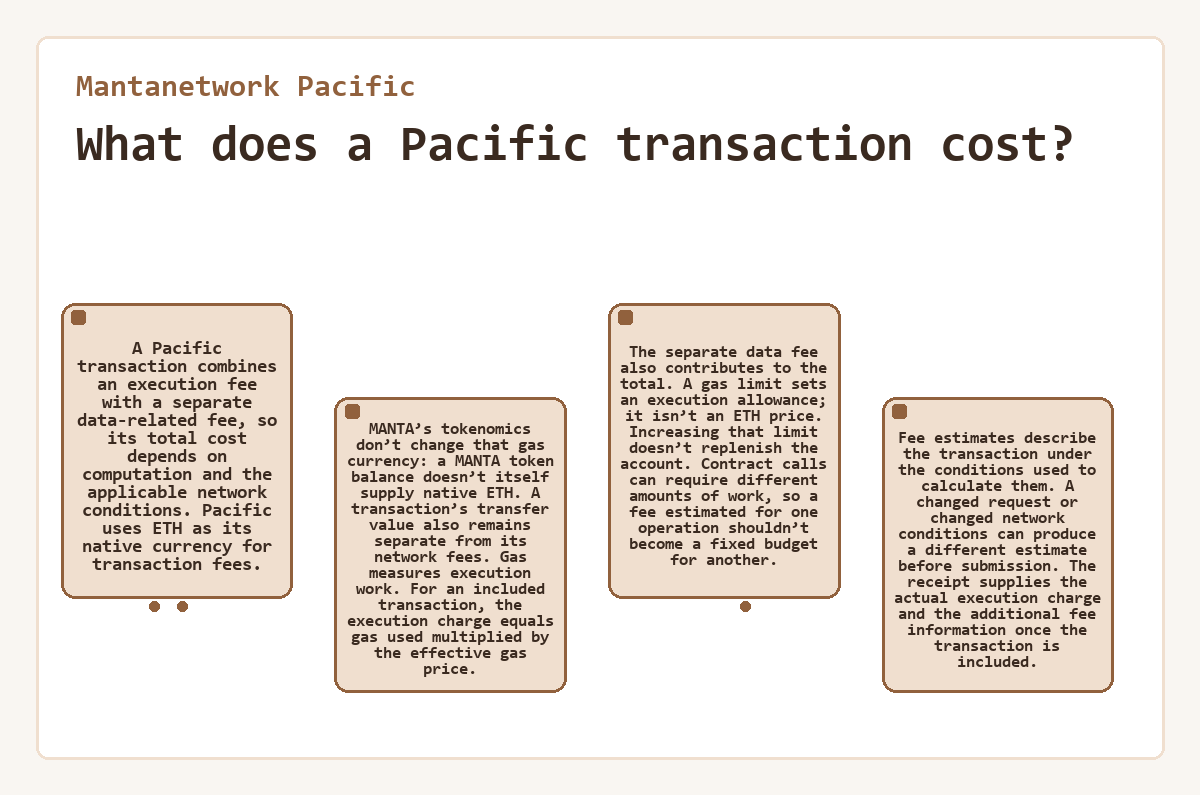
Fee estimates describe the transaction under the conditions used to calculate them. A changed request or changed network conditions can produce a different estimate before submission. The receipt supplies the actual execution charge and the additional fee information once the transaction is included.
Solidity code and local contract dependencies
Solidity deployments on Pacific can use familiar Ethereum tooling, including Hardhat and Foundry, while their configuration must identify the intended Pacific network. Pacific can execute standard Ethereum smart contract code. Compatibility covers execution; an application’s contract addresses, token contracts and external services still need correct configuration. A contract deployed elsewhere doesn’t appear on Pacific just because its code is compatible. The frontend must connect to the same network as its deployed contracts.
Sequencing, data availability and Ethereum settlement
Pacific’s infrastructure divides transaction processing across a sequencer, a data-availability layer and Ethereum settlement, with each component handling a different dependency. The sequencer orders transactions for Layer 2 execution. Celestia provides Pacific’s data-availability layer. Publishing batch data makes the information available for nodes following the chain. This function supports the rollup’s operation without changing the application’s contract logic or the currency a wallet uses for gas.
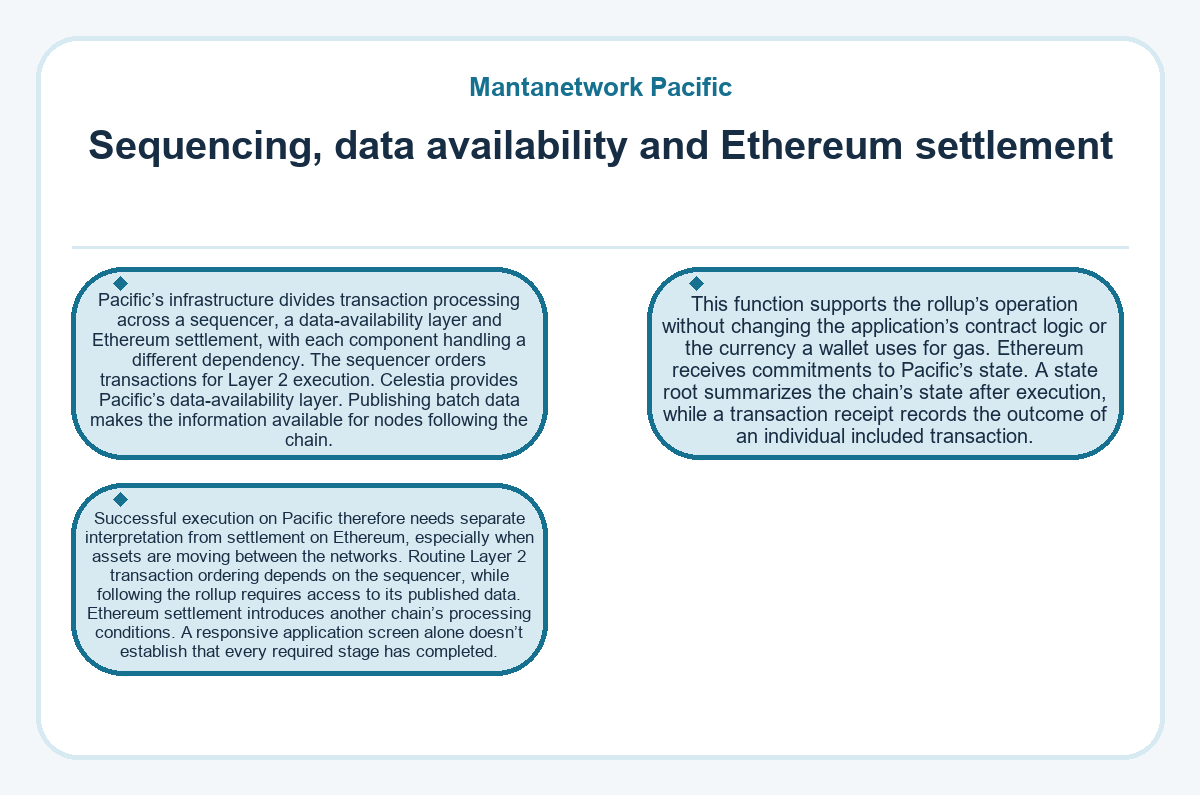
Ethereum receives commitments to Pacific’s state. A state root summarizes the chain’s state after execution, while a transaction receipt records the outcome of an individual included transaction. Successful execution on Pacific therefore needs separate interpretation from settlement on Ethereum, especially when assets are moving between the networks.
Routine Layer 2 transaction ordering depends on the sequencer, while following the rollup requires access to its published data. Ethereum settlement introduces another chain’s processing conditions. A responsive application screen alone doesn’t establish that every required stage has completed.
An ETH transfer with a changing fee estimate
In this hypothetical example, a wallet requests a native ETH transfer between ordinary accounts on Pacific mainnet. The sending balance, transfer amount, fee budget and transaction states are assumed for this case. Neither account has other transactions during the example, so the recipient’s balance change can be attributed to this transfer.
The wallet first checks chain ID 169 and its native ETH balance on that network. Let B be that balance, V the transfer amount and F the wallet’s current total fee funding requirement, all expressed in ETH. Sending V requires B to cover V plus F. ETH held only on Ethereum mainnet doesn’t contribute to B.
On the normal path, the wallet still has enough ETH after refreshing the estimate and broadcasts the signed transaction. Its hash identifies the submitted request. Once the transaction record matches the recipient and transfer value and its receipt shows success, the receiving balance increases by V. The sending balance falls by V plus the actual network fee, which can differ from the earlier fee budget.
In the edge case, an updated fee requirement pushes V plus F above B before broadcast. The gas currency hasn’t changed; the live funding requirement no longer fits the balance. Reducing V or adding native ETH to the Pacific account can restore coverage, subject to a refreshed estimate. Without a broadcast, the recipient receives no ETH from this request.
A submitted transfer with a pending status needs a different response from a funding rejection. Reconcile the existing hash with Pacific’s transaction record before creating another transfer. If a successful receipt and the recipient’s chain balance show the expected credit while the wallet displays an older balance, refresh the wallet’s Pacific data before sending anything again. A pending record alone doesn’t establish failure or receipt of ETH.
Privacy at the application boundary
Pacific records ordinary transaction addresses and contract interactions on a public chain, while privacy for protected inputs depends on an application’s proof design. A zero-knowledge proof can establish a statement without revealing its private witness, the secret information used to produce the proof. Public inputs remain part of the verification process. Using a ZK-capable application doesn’t automatically conceal an ordinary ETH transfer’s sender, recipient or value. Privacy depends on which information the specific operation keeps private and which information it publishes.
When does a native withdrawal reach Ethereum?
A native Pacific withdrawal reaches Ethereum when its finalization transaction succeeds and delivers the asset to the intended recipient under the bridge’s active conditions. Native withdrawals have distinct states for initiation, readiness to prove, the challenge period and readiness for relay. The process includes proving the withdrawal before finalization. A successful Pacific withdrawal transaction records the source-chain action; it doesn’t establish that the recipient already has the asset on Ethereum.
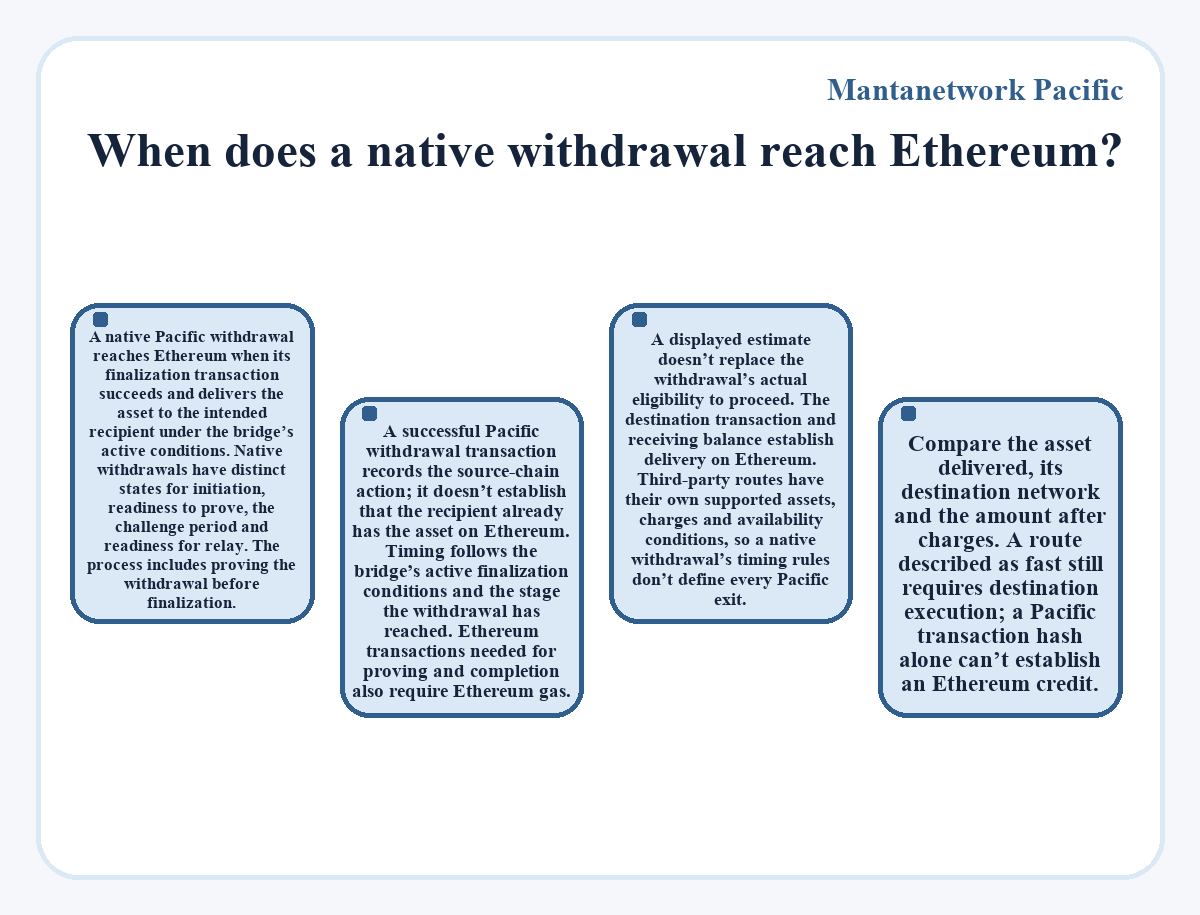
Timing follows the bridge’s active finalization conditions and the stage the withdrawal has reached. Ethereum transactions needed for proving and completion also require Ethereum gas. A displayed estimate doesn’t replace the withdrawal’s actual eligibility to proceed. The destination transaction and receiving balance establish delivery on Ethereum.
Third-party routes have their own supported assets, charges and availability conditions, so a native withdrawal’s timing rules don’t define every Pacific exit. Compare the asset delivered, its destination network and the amount after charges. A route described as fast still requires destination execution; a Pacific transaction hash alone can’t establish an Ethereum credit.
Still wondering about Mantanetwork Pacific?
Is an ERC-20 token approval on Pacific proof of a completed dApp action?
An ERC-20 token approval on Pacific grants the specified spender an allowance for that token. It establishes permission to spend, while the application’s requested action has its own outcome. The spender address and allowance determine the permission granted. Whether another wallet request follows depends on the application’s implementation.
What separates an RPC connection problem from a Pacific chain outage?
A failing RPC endpoint doesn’t by itself establish a Pacific chain outage. An RPC, or remote procedure call, connects the wallet or application to a node serving network data. An endpoint can stop responding independently of block production. Block freshness through another Pacific endpoint or explorer helps distinguish a connection problem from stalled network progress.
Can a failed Pacific contract transaction still consume ETH?
A Pacific transaction included in a block can consume ETH for gas even when its top-level contract execution reverts. The intended state changes roll back, while execution already performed still incurs fees. A request rejected before broadcast has no on-chain execution charge, although separate transactions completed earlier retain their own fees.
Does importing a token into a Pacific wallet change its on-chain balance?
Importing a token into a Pacific wallet adds information for displaying its existing contract balance. It doesn’t mint tokens or perform a bridge transfer. The wallet needs the correct Pacific token contract to read that balance. A token’s ticker alone can’t distinguish its contract from another token using the same symbol.
Will reading a Pacific contract require an ETH payment?
Reading Pacific contract data through an off-chain call doesn’t require an on-chain gas payment. Calling the same function inside a broadcast transaction can consume gas, including when the function only reads state. A public contract query also doesn’t need token-spending permission simply to return its data.
Are Pacific testnet fees paid from a mainnet ETH balance?
Pacific’s Sepolia testnet uses its own ETH balances, so a mainnet balance can’t pay a testnet transaction fee. The test environment has chain ID 3441006 and separate contract deployments. Matching account addresses and currency labels don’t merge funds across environments. Testnet receipts describe test execution without recording mainnet transfers.